 An official website of the United States government.
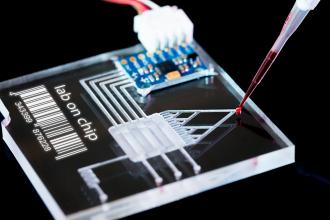
The “3Rs alternatives” refers to the replacement, reduction, and refinement of animals used in research, teaching, testing, and exhibition. Drs. William Russell and Rex Burch first described the 3Rs in 1959 in their book, "The Principles of Humane Experimental Technique". Russell and Burch advocated for new scientific approaches that would minimize pain and distress of research animals, while maintaining scientific integrity.
Defining the 3Rs
- Replacement refers to technologies or approaches that directly replace or avoid the use of animals. Replacement can be broken down into two categories: Full/Absolute and Partial/Relative.
- Full/Absolute Replacement avoids the use of animals completely. Some examples include training manikins, human tissues and cells, computer models, and microphysiological systems.
- Partial/Relative Replacement still requires animal use, but the animals do not experience pain or distress during the study. Some examples include animal-derived tissue/organs for in vitro studies, zebrafish embryos, and transcutaneous electrical resistance test (TER).
- Reduction involves methods that help obtain comparable levels of information from the use of fewer animals. Scientists can reduce the number of animals used in research through strategies such as appropriate experimental design, correct statistical evaluation, and sharing resources/animals.
- Refinement refers to modifications of husbandry or experimental procedures that minimize or eliminate animals’ pain and distress and improve their welfare. A few examples of refinement are anesthetics and analgesics, humane animal handling, environmental enrichments, and humane endpoints.
Definitions from ‘The Principles of Humane Experimental Technique’ (1959) and the ‘Guide for the Care and Use of Laboratory Animals’ (2011).
3Rs Funding Opportunities
- The National Cancer Institute funds the Cancer Tissue Engineering Collaborative: Enabling Biomimetic Tissue-Engineered Technologies for Cancer Research (R01 Clinical Trial Optional).
- Deadline: June 5, 2022, and quarterly thereafter through February 2025
- The Alternatives Research & Development Foundation (ARDF) offers their Annual Open Grant Program to fund research projects that promote the development, validation, and adoption of non-animal methods in biomedical research, product testing, and education.
- Deadline: April 19, 2024
- The International Foundation for Ethical Research (IFER) funds Graduate Student Fellowships for those enrolled in master's or Ph.D. programs and whose proposals show the greatest potential to replace or reduce the use of animals in research, testing, and/or education
- Deadline: April 30, 2024
- The National Centre for the Replacement, Refinement & Reduction of Animals in Research (NC3Rs) is offering the International 3Rs Prize to authors who have published a paper related to the replacement, reduction, or refinement of animals in research.
- Deadline: May 1, 2024
- The Association for Assessment and Accreditation of Laboratory Animal Care (AAALAC) International funds The Global 3Rs Awards Program for those that have made contributions toward the 3Rs (replacement, reduction, and refinement) of animal research.
- Deadline: June 1, 2024
- The U.S. Department of Agriculture's (USDA) Agriculture and Food Research Initiative (AFRI) funds the Foundational and Applied Science Program, which supports grants focused on the welfare and well-being of agricultural animals (A1251).
- Deadline: December 31, 2024
- PETA Science Consortium International e.V., the Physicians Committee for Responsible Medicine (PCRM), and the Alternatives Research and Development Foundation's (ARDF) Recombinant Antibody Challenge offers free catalogue recombinant antibodies for use in research and testing. These antibodies would replace animal-derived monoclonal or polyclonal antibodies.
- Deadline: Rolling deadline
- The Universities Federation for Animal Welfare (UFAW) offers Research and Project Awards (over £3,500) and Small Project and Travel Awards (up to £3,500) for research or other animal welfare projects or activities (e.g. educational initiatives, publications, purchase of equipment, etc.).
- Deadline: Rolling deadline


Finding 3Rs Literature and Resources
Alternatives Literature Searching
USDA. NAL. Animal Welfare Information Center (AWIC).
AWIC provides a step-by-step guide to literature searching for alternatives, examples of literature searches, best databases for 3Rs alternatives literature, and more.
Other 3Rs Organizations
Other 3Rs organizations offer information for various 3Rs methods and technologies. Some also share their goals for validation and acceptance of 3Rs alternatives in animal research.
Mention of commercial enterprises or brand names does not constitute endorsement or imply preference by the U.S. Department of Agriculture.
3Rs Organizations
AltTox is dedicated to advancing non-animal methods of toxicity testing and helps with the exchange of technical and policy information on in vitro and in silico methods for toxicity testing.
European Concensus-Platform for Alternatives (ecopa)
This pan-European platform is a mechanism to reach consensus between interested parties (i.e. animal welfare organizations, industry, academia, and governmental institutions) for stimulating 3Rs alternatives research and enforcing the acceptance of alternatives in experimental practice.
European Partnership for Alternative Approaches to Animal Testing (EPAA)
EPAA partners aim to accelerate the development, validation, and acceptance of alternative approaches at national, European, and global levels.
European Union Reference Laboratory for Alternatives to Animal Testing (EURL ECVAM)
This reference laboratory focuses on the development and scientific and regulatory acceptance of alternative testing methods aimed at replacing, reducing or refining the use of laboratory animals.
Fund for the Replacement of Animals in Medical Experiments (FRAME)
FRAME provides 3Rs resources focusing on the replacement of laboratory animals.
Interagency Coordinating Committee on the Validation of Alternative Methods (ICCVAM)
ICCVAM and its supporting center, NICEATM (National Toxicology Program Interagency Center for the Evaluation of Alternative Toxicological Methods), coordinate the development, validation, acceptance, and harmonization of alternative toxicological test methods throughout the United States federal government.
International Foundation for Ethical Research (IFER)
IFER funds animal use alternatives research to advance the development, validation, and implementation of methodologies that replace or reduce the use of animals in research, testing and education.
International Network for Humane Education (InterNICHE)
InterNICHE is a network of students, teachers and animal campaigners that focus on animal use and alternatives within biological science, medical, and veterinary medical education.
Institute for Laboratory Animal Research (ILAR)
ILAR develops and makes available scientific and technical information on laboratory animals and other biological research resources through reports, books, and a journal.
Johns Hopkins Center for Alternatives to Animal Testing (CAAT)
CAAT offers 3Rs funding, in vitro toxicology resources, and publishes the open access journal, ALTEX (Alternatives to Animal Experimentation).
National Centre for the Replacement, Refinement and Reduction of Animals in Research (NC3Rs)
NC3Rs shares a variety of resources on 3Rs methods and technologies for different animal species used in research.
Netherlands National Committee for the Protection of Animals Used for Scientific Purposes (NCad)
NCad provides advisory reports, best practices and other documents regarding 3Rs alternatives.
Norecopa maintains approximately 9,000 webpages that contain articles, videos, presentations, reports, photos and more on 3Rs alternatives methods and technologies.
The North American 3Rs Collaborative (NA3RsC)
NA3RsC work with partners across academia, industry, and more to drive key initiatives such as rodent health monitoring, microphysiological systems, and compassion fatigue.
Universities Federation for Animal Welfare (UFAW)
UFAW develops and promotes improvements to animal welfare through research, education, publications, and more.
Annual 3Rs Symposium
The Annual 3Rs Symposium brings together investigators, veterinarians, animal care staff, Institutional Animal Care and Use Committee (IACUC) members, and others involved in animal research to discuss 3Rs methods and techniques for a wide range of animals used in research. The 2013 through 2019 symposiums focused on social housing of laboratory animals, whereas symposiums after 2019 focused more generally on 3Rs topics. The symposium is jointly hosted by USDA's, NAL, Animal Welfare Information Center (AWIC); NIH's Office of Laboratory Animal Welfare (OLAW); the Johns Hopkins Department of Molecular and Comparative Pathobiology; and the Johns Hopkins Center for Alternatives to Animal Testing (CAAT).
View past Annual 3Rs Symposiums for free
View presentations on liver-chip technologies, environmental health monitoring, refinement and enrichment strategies, regulatory insights into the 3Rs among other topics
Watch presentations on mixed strain housing, best animal models for disease research, adoption programs, collaborating to solve animal welfare issues and other topics
Find talks on 3Rs in machine learning and literature searching, animal models in COVID research, microphysiological systems, assessing animal welfare and other topics
View presentations on minibrain organoids, grimace scales, PRIMatE data exchange, using pets in research, rodent and pig handling, and PREPARE guidelines among other topics
Find discussions on zoo animals, rabbits, mice, and rats
Watch presentations on fish, rats, mice rabbits, and miniature swine
View talks on rabbits and miniature swine
Watch discussions on nonhuman primates, zebrafish, and amphibians
Find talks on ruminants, nonhuman primates, rabbits, guinea pigs, and hamsters
View presentations on rabbits, pigs, and nonhuman primates
Additional Resources
Measuring U.S. Federal Agency Progress Toward Implementation of Alternative Methods in Toxicity Testing
Interagency Coordinating Committee on the Validation of Alternative Methods (ICCVAM).
This document describes the recommendations of the ICCVAM Metrics Workgroup along with references and other materials that can be used to follow federal agency progress in promoting the use of alternative toxicological methods.
The Principles of Humane Experimental Technique
John Hopkins Center for Alternatives to Animal Testing.
Drs. Russell and Burch were the creators of the 3Rs concept in animal research. The concept was published in their 1959 book, "The Principles of Humane Experimental Technique".
PREPARE Guidelines
Norecopa.
PREPARE (Planning Research and Experimental Procedures on Animals: Recommendations for Excellence) is a set of guidelines to help researchers with planning experiments involving animals. Considering 3Rs alternatives is part of the planning.