 An official website of the United States government.



Supplemental lysine sulfate does not negatively affect performance of broiler chicks fed dietary sulfur from multiple dietary and water sources
Title
Supplemental lysine sulfate does not negatively affect performance of broiler chicks fed dietary sulfur from multiple dietary and water sources
Date
Subject
Excerpt
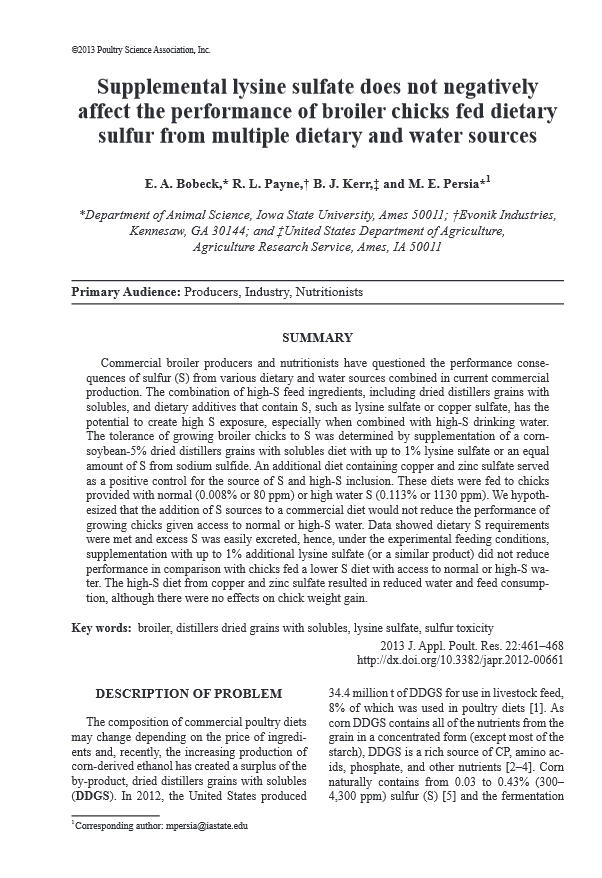
Commercial producers and nutritionists have questioned the performance consequences of sulfur (S) from various dietary and water sources combined in current commercial production. The combination of high S containing feed ingredients, including dried distiller’s grains with solubles (DDGS) and dietary additives that contain S such as lysine sulfate or copper sulfate, has the potential to create high S exposure, especially when combined with high S drinking water. The tolerance of growing broiler chicks to S was determined by supplementation of a corn-soybean- 5% DDGS diet with up to 1% lysine sulfate or an equal amount of S from sodium sulfide. An additional diet containing copper and zinc sulfate served as a positive control for source of S and high S inclusion. These diets were fed to chicks provided with normal or high water S. We hypothesized that the addition of S sources to a commercial diet would not reduce the performance of growing chicks given access to normal or high S water. Data showed dietary S requirements were met and excess S was easily excreted, hence under the experimental feeding conditions, supplementation with up to 1% additional lysine sulfate (or similar product) did not reduce performance in comparison with chicks fed a lower S diet with access to normal or high S water. Analysis of the high S diet from copper and zinc sulfate suggests reduced water and feed consumption although there were no effects on chick weight gain.
Relation
Journal of Applied Poultry Research
Volume 22
pp. 461-468