Norecopa.
Provides a video, images, and peer-reviewed articles demonstrating the use of 3 fingers rather than 2 as a refinement to mouse scruffing.
Norecopa.
Provides a video, images, and peer-reviewed articles demonstrating the use of 3 fingers rather than 2 as a refinement to mouse scruffing.
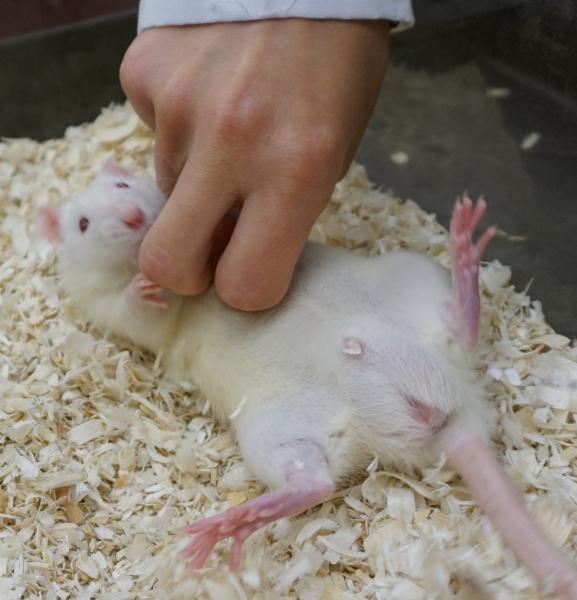
Rat tickling is a technique that mimics how rats playfully socialize with each other. Rat tickling reduces fearful reactions to humans and creates beneficial effects when rats are handled.
Newcastle University. Assessing the Health and Welfare of Laboratory Animals.
Features videos, images and text of veterinary staff demonstrating proper procedures for handling small mammals.
Temple Grandin. Colorado State University.
Reducing stress during livestock handling improves productivity and prevents physiological changes that could confound research results.
National Centre for the Replacement, Refinement and Reduction of Animals in Research.
This NC3Rs page on the Handling and Restraint of laboratory animals has the latest guidance on handling and restraint.
NIH. Office of Animal Care and Use (OACU).
The training tools and multimedia resources provided on this website are intended to assist investigators in learning proper handling techniques and technical procedure methodology.
American Fisheries Society.
These guidelines focus on valid experimental design and procedures with aquatic animals while ensuring humane treatment.
Ishiyama, S., Kaufmann, L. V., & Brecht, M. (2019). Behavioral and Cortical Correlates of Self-Suppression, Anticipation, and Ambivalence in Rat Tickling. Current Biology, 29(19), 3153-3164.e3. https://doi.org/10.1016/j.cub.2019.07.085
LaFollette, M.R., Cloutier, S., Brady, C., Gaskill, B. N., & O’Haire, M. E. (2019). Laboratory animal welfare and human attitudes: A cross-sectional survey on heterospecific play or “rat tickling.” PLoS ONE, 14(8). https://doi.org/10.1371/journal.pone.0220580
LaFollette, Megan R., O’Haire, M. E., Cloutier, S., Blankenberger, W. B., & Gaskill, B. N. (2017). Rat tickling: A systematic review of applications, outcomes, and moderators. PloS One, 12(4), e0175320. https://doi.org/10.1371/journal.pone.0175320
Cloutier, S., LaFollette, M. R., Gaskill, B. N., Panksepp, J., & Newberry, R. C. (2018). Tickling, a technique for inducing positive affect when handling rats. Journal of Visualized Experiments, 2018(135). https://doi.org/10.3791/57190
Cloutier, S., Wahl, K. L., Panksepp, J., & Newberry, R. C. (2015). Playful handling of laboratory rats is more beneficial when applied before than after routine injections. Applied Animal Behaviour Science, 164, 81–90. https://doi.org/10.1016/j.applanim.2014.12.012
Labitt, R. N., Oxford, E. M., Davis, A. K., Butler, S. D., & Daugherity, E. K. (2021). A Validated Smartphone-based Electrocardiogram Reveals Severe Bradyarrhythmias during Immobilizing Restraint in Mice of Both Sexes and Four Strains. Journal of the American Association for Laboratory Animal Science : JAALAS, 60(2), 201–212. https://doi.org/10.30802/AALAS-JAALAS-20-00006
Henderson, L. J., Dani, B., Serrano, E. M. N., Smulders, T. V., & Roughan, J. V. (2020). Benefits of tunnel handling persist after repeated restraint, injection and anaesthesia. Scientific Reports, 10(1), 14562. https://doi.org/10.1038/s41598-020-71476-y
Gouveia, K., & Hurst, J. L. (2019). Improving the practicality of using non-aversive handling methods to reduce background stress and anxiety in laboratory mice. Scientific Reports, 9(1), 20305. https://doi.org/10.1038/s41598-019-56860-7
Doerning, C. M., Thurston, S. E., Villano, J. S., Kaska, C. L., Vozheiko, T. D., Soleimanpour, S. A., & Lofgren, J. L. (2018). Assessment of mouse handling techniques during cage changing. Journal of the American Association for Laboratory Animal Science, 58(6), 767–773. https://doi.org/10.30802/AALAS-JAALAS-19-000015
Nakamura, Y., & Suzuki, K. (2018). Tunnel use facilitates handling of ICR mice and decreases experimental variation. The Journal of Veterinary Medical Science, 80(6), 886–892. https://doi.org/10.1292/jvms.18-0044
Gouveia, K., & Hurst, J. L. (2017). Optimising reliability of mouse performance in behavioural testing: The major role of non-aversive handling. Scientific Reports, 7(1), 44999. https://doi.org/10.1038/srep44999
Leidinger, C., Herrmann, F., Thöne-Reineke, C., Baumgart, N., & Baumgart, J. (2017). Introducing clicker training as a cognitive enrichment for laboratory mice. Journal of Visualized Experiments, 2017(121). https://doi.org/10.3791/55415