
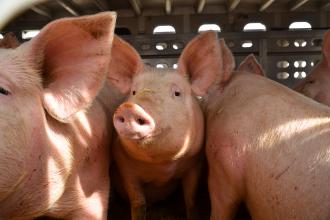
The Twenty-Eight Hour Law was originally passed on March 3, 1873. The law was then repealed and reenacted in 1906 and again in 1994 to set humane standards for the transportation of livestock. If livestock are being transported for longer than 28 consecutive hours, they must be offloaded for at least 5 consecutive hours to get feed, water, and rest. The U.S. Department of Agriculture enforces the Law.
Current Law and Regulations
- Twenty-Eight Hour Law [uscode.house.gov] - The current law passed by U.S. Congress and incorporated into the United States Code (U.S.C) at 49 U.S.C. 80502. The statute gives USDA authority to make regulations to implement and enforce the law.
- Twenty-Eight Hour Law Regulations [ecfr.gov] - The Code of Federal Regulations (C.F.R.), specifically 9 C.F.R. Part 89, provides detailed guidance, standards, and rules drafted and adopted by USDA to enforce the Twenty-Eight Hour Law.
Twenty-Eight Hour Law in the Literature
Use the resources and materials below, which include books and documents from the U.S. Statutes at Large, U.S. Code, and Federal Register, to learn about the history and modifications of the Twenty-Eight Hour Law. If you have any questions about accessing materials from the National Agricultural Library, contact us.
Animal Transport: Congress Should Consider Modernizing the Law to Better Protect Livestock
This 2026 report examines how effectively the Twenty‑Eight Hour Law addresses factors that may prevent cruelty of livestock during transport and the steps federal agencies take to oversee compliance and enforcement of the law. It also makes recommendations to Congress on amendments to the law.
Frequently Asked Questions
Yes, there are a few exceptions stated in the law: 49 U.S.C. § 80502 (2026).
1. Animals transported by air or water are exempt (§ 80502 (a)(1)).
2. Sheep may be confined for an additional 8 consecutive hours without being unloaded if their period of confinement ends at night (§ 80502 (2)).
3. Animals can be confined longer than 28 consecutive hours when the animals can't be unloaded due to accidental or unavoidable causes (§ 80502 (2)(A)).
4. Animals can be confined for up to 36 consecutive hours if it's requested in writing (§ 80502 (2)(B)).
5. If animals have access to feed, water, and rest during transport, then these animals are exempt (§ 80502 (3)(c)).
The term "animal" is not defined in the Twenty-Eight Hour Law. However, in the annotated version (The twenty-eight hour law annotated Act of Congress approved June 29, 1906, C. 3594, 34 stat. 607) the term animals describes "cattle, sheep, swine, or other animals" (pg. 7), where other animals refers to "mules and horses" (pg. 13).
If animals are to be transported for longer than 28 consecutive hours (49 U.S.C. § 80502 (a)(1)(2026)) then they must be offloaded for at least 5 consecutive hours (49 U.S.C. § 80502 (b)(2026)).
No, the law does not discuss the transportation of livestock to other countries.
From 49 U.S.C. § 80502 (a)(1)(2026):
"...vessel transporting animals from a place in a State, the District of Columbia, or a territory or possession of the United States through or to a place in another State, the District of Columbia, or a territory or possession, may not confine animals in a vehicle or vessel for more than 28 consecutive hours without unloading the animals for feeding, water, and rest."